
There is no doubt the United Kingdom is in a precarious position because of a growing internal threat of extremist terrorism. The Muslim community is in a state of growth within the UK, but does that mean the UK should fail to step forward in support of the US as an ally? This is quite the conundrum, and there are many issues to take into consideration, both domestically and politically as well as strategically.
Strategic caution, domestic pressures, and the geopolitical balancing act
Key Intelligence Assessment
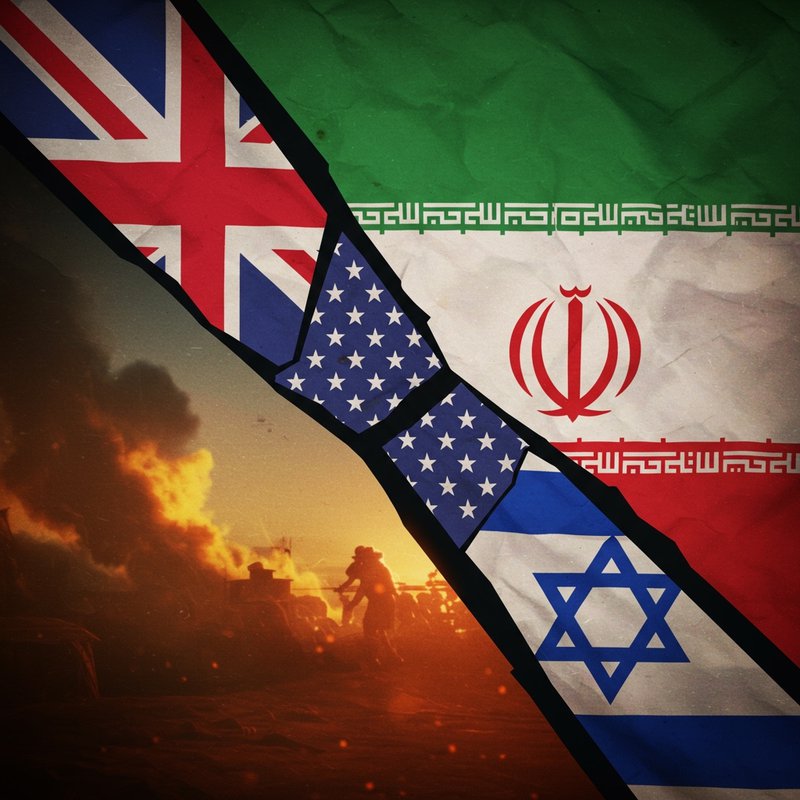
The United Kingdom’s refusal to join the initial U.S.–Israeli military strikes against Iran in February 2026 appears to reflect a deliberate strategy: maintain alliance solidarity while avoiding immediate entanglement in a rapidly expanding Middle East war.
London’s position reflects three converging pressures:
- Strategic alliance obligations with the United States and Israel
- Legal and diplomatic concerns over the legitimacy of the strikes
- Domestic political and security considerations inside the United Kingdom
Together these factors explain why Britain has adopted a defensive‑support posture rather than direct participation in the conflict.
The War That Changed the Strategic Landscape
In late February 2026, the United States and Israel launched coordinated strikes against Iranian military infrastructure, nuclear facilities, and leadership targets. The attacks followed the collapse of negotiations aimed at limiting Iran’s nuclear and ballistic missile programs.
Iran responded with retaliatory drone and missile attacks targeting U.S. bases and allied infrastructure across the region. The confrontation quickly spread beyond Iran and Israel, affecting energy routes, global shipping, and regional stability.
One of the most consequential developments has been the disruption of the Strait of Hormuz, the narrow maritime corridor through which roughly one fifth of the world’s oil supply normally flows. With tanker traffic reduced and oil prices surging, the conflict has already produced global economic consequences.
Britain’s Decision: Support Without Direct War
Despite its close alliance with Washington, the United Kingdom chose not to participate in the initial offensive strikes against Iran.

Instead, the British government has adopted a limited support role which includes:
• deploying fighter aircraft to intercept drones and missiles • reinforcing regional defense positions • sharing intelligence with allied forces
This posture allows Britain to support allied defense efforts while maintaining legal and diplomatic distance from the offensive campaign.
Europe’s Fragmented Response
Britain’s caution is not occurring in isolation. Across Europe, governments were caught off guard by the speed and scale of the U.S.–Israeli operation.
The result has been a fragmented response:
• some European states have deployed defensive assets • others have prioritized diplomatic mediation • several have avoided direct military involvement
This fragmentation highlights a broader concern among European governments: the fear that the conflict could evolve into a full regional war.
Domestic Political Pressure in the United Kingdom
Foreign policy decisions rarely occur in isolation from domestic politics. Public sentiment in Britain remains cautious toward military intervention in the Middle East.
The legacy of the Iraq War continues to influence public perception of military action in the region. Political leaders are therefore aware that deeper involvement in another Middle Eastern conflict could become politically contentious.
The Domestic Security Dimension
Modern conflicts rarely remain geographically contained. In highly connected societies, wars abroad can rapidly create political reverberations at home.
Security agencies in the United Kingdom closely monitor potential risks linked to Middle Eastern conflicts including:
• foreign influence operations • espionage networks • cyber activity • extremist mobilization
This domestic "echo effect" means that geopolitical conflicts abroad can quickly influence security planning within European states.
Strategic Map of the Conflict Theatre

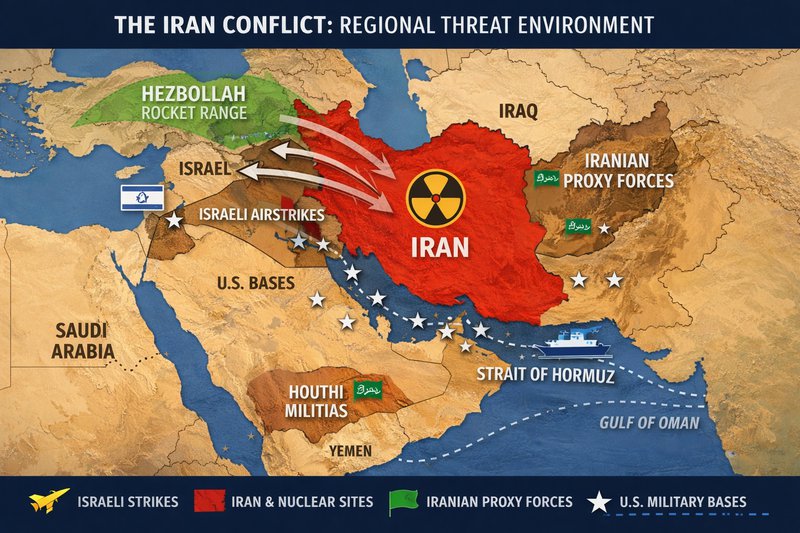
A geopolitical map of the current conflict illustrates how rapidly the confrontation could expand beyond Iran and Israel.
Key strategic zones include:
IRAN – the central theatre of the current conflict, including nuclear facilities, missile bases, and Revolutionary Guard infrastructure.
ISRAEL – primary military actor alongside the United States, conducting targeted strikes against Iranian strategic assets.
PERSIAN GULF – critical maritime zone hosting U.S. bases and vital oil infrastructure across Gulf states.
STRAIT OF HORMUZ – global energy chokepoint through which roughly 20 percent of the world’s oil supply passes.
IRAQ AND SYRIA – potential proxy battlegrounds where Iranian‑aligned militia groups operate.
LEBANON – Hezbollah presence creates risk of a northern front against Israel.
RED SEA AND GULF OF ADEN – vulnerable shipping lanes that could be targeted by proxy groups or missile attacks.
Any expansion across these regions could transform the current conflict into a broader Middle Eastern war.
Possible Escalation Scenarios
Security analysts are monitoring several developments that could force Britain and other Western governments to reassess their position.
Scenario 1 – Regional War
If Iranian retaliation expands to include large‑scale attacks on U.S. or allied bases across the Middle East, NATO states could be drawn into direct conflict.
Scenario 2 – Energy Shock
Further disruption of the Strait of Hormuz could trigger a global energy crisis, dramatically increasing pressure on Western governments to intervene.
Scenario 3 – Proxy Escalation
Iran‑aligned groups in Lebanon, Iraq, Syria, and Yemen could open additional fronts, widening the conflict beyond the initial battlefield.
Scenario 4 – Cyber and Hybrid Warfare
Iran has historically used cyber operations and asymmetric tactics to target Western infrastructure and financial systems.
Risk Forecast: Europe and the United Kingdom
From an intelligence perspective, several risks could emerge over the next twelve months if the conflict continues to escalate.
1. Energy and Economic Pressure
A sustained disruption to Gulf oil supplies would increase energy prices across Europe, worsening inflation and economic instability.
2. Maritime Security Threats
Shipping routes through the Red Sea and the Strait of Hormuz could become targets for missile or drone attacks.
3. Cyber Operations
European infrastructure including financial institutions, telecommunications networks, and government systems may face increased cyber activity.
4. Domestic Political Polarization
Wars in the Middle East often generate strong political reactions across European societies, increasing social tensions and protest activity.
5. Intelligence and Counter‑Espionage Activity
European intelligence agencies are likely to increase monitoring of foreign influence networks connected to Middle Eastern actors.
Britain at the Inflection Point
For now, Britain appears determined to walk a narrow strategic line.
It is supporting its allies, reinforcing regional defenses, and preparing for escalation — but it has deliberately stopped short of joining the war itself.
Whether that balance can be maintained will depend largely on how the conflict evolves in the coming weeks.
If the confrontation expands into a broader regional war, Britain may soon face a decision confronting many Western governments:
remain strategically cautious — or join a conflict whose consequences are still unfolding.
Five Strategic Reasons Britain Stayed Out of the Initial Strikes
1. Legal Ambiguity Around the Opening Attacks
British policymakers appear cautious about participating in offensive military operations without a clear legal framework under international law. By limiting involvement to defensive support, the UK preserves legal and diplomatic flexibility.
2. Avoiding Immediate Escalation With Iran
Direct participation in the first wave of strikes could have placed British bases, ships, and diplomatic missions directly within Iran’s retaliation plans.
3. Protecting Maritime and Energy Interests
The United Kingdom has substantial strategic interests tied to Gulf energy routes and global maritime stability. Remaining outside the initial strikes may help London maintain leverage in protecting shipping routes if the crisis expands.
4. Domestic Political Sensitivities
Public opinion in Britain remains wary of large-scale military involvement in Middle Eastern conflicts following the legacy of Iraq and Afghanistan.
5. Maintaining Diplomatic Leverage
By not participating in the opening offensive, Britain retains potential credibility as a diplomatic intermediary should negotiations re‑emerge.
Conflict Escalation Timeline (Strategic Overview)
2023–2024
Iran accelerates uranium enrichment and expands ballistic missile development while tensions rise with Israel over regional proxy activity.
2024–2025
Multiple covert cyber operations, targeted assassinations, and proxy attacks occur across the Middle East as Israel and Iran intensify their shadow conflict.
Late 2025
Diplomatic negotiations attempting to limit Iran’s nuclear program collapse amid growing mistrust between Tehran and Western powers.
February 2026
The United States and Israel launch coordinated strikes against Iranian nuclear and military infrastructure in an attempt to degrade Iran’s strategic capabilities.
March 2026
Iran retaliates through missile and drone attacks across the region, increasing the risk of a wider Middle Eastern war and triggering global energy market instability.
Strategic Conflict Map (Middle East Theatre)
[INSERT MAP IMAGE HERE – Iran Conflict Strategic Map]
Note for developer/designer: place the geopolitical map graphic showing Iranian nuclear sites, Israeli strike vectors, proxy force regions, U.S. military bases, and the Strait of Hormuz energy corridor at this location in the article layout.
Strategic overview of the Iran–U.S.–Israel conflict environment showing Iranian nuclear sites, Israeli strike vectors, proxy force regions, U.S. military bases, and global energy shipping routes through the Strait of Hormuz.
Below is a simplified strategic overview map illustrating the primary conflict zones and maritime choke points relevant to the Iran–U.S.–Israel confrontation.
                     EUROPE
                        |
                        |
                -----------------
                |               |
             TURKEY          CASPIAN SEA
                |               |
                |            IRAN
                |          (Nuclear &
                |        Missile Sites)
                |
          SYRIA ----- IRAQ
            |            |
            |            |
        LEBANON        PERSIAN GULF
       (Hezbollah)        |
            |             |
         ISRAEL --------- |
        (Air Strikes)     |
                          |
                 STRAIT OF HORMUZ
               (Global Energy Chokepoint)
                          |
                        OMAN
                          |
                    ARABIAN SEA

   Proxy & Strategic Zones

   • Lebanon – Hezbollah missile network
   • Syria / Iraq – Iranian aligned militia activity
   • Persian Gulf – U.S. bases and allied infrastructure
   • Strait of Hormuz – global oil shipping route
   • Red Sea corridor – vulnerable maritime trade route
This simplified map highlights the geographic relationships driving escalation risk: Iranian territory, Israeli strike range, proxy regions in Lebanon and Syria, and the global energy chokepoint at the Strait of Hormuz.
• Iran nuclear and missile sites • Israeli strike routes • proxy conflict zones • U.S. regional bases • global energy shipping routes
Intelligence Forecast: Will Britain Enter the War?
Based on current strategic indicators, the probability of direct British entry into the conflict depends on several triggers.
Trigger 1 – Direct Attack on British Assets
An Iranian strike on British bases, naval vessels, or citizens would significantly increase the likelihood of military participation.
Trigger 2 – NATO Collective Defense Dynamics
If escalation involves NATO member states or triggers alliance defense obligations, Britain could be drawn into coordinated military operations.
Trigger 3 – Regional War Expansion
A broader regional war involving Hezbollah, Gulf states, or widespread proxy conflicts could force Britain to intervene to stabilize maritime and security interests.
Trigger 4 – Energy Security Collapse
Severe disruption of global energy supply through the Strait of Hormuz could push Western governments toward stronger military action to restore shipping security.
Strategic Outlook
The Iran–U.S.–Israel confrontation represents one of the most volatile geopolitical crises of the decade. While Britain has so far maintained a cautious strategic distance, the rapidly evolving nature of the conflict means that the situation remains fluid.
For the moment, London appears determined to balance alliance commitments with diplomatic restraint. Whether that strategy holds will depend on the trajectory of the conflict in the months ahead.
If escalation continues, Britain — like many Western governments — may soon face a strategic decision that cannot be deferred indefinitely.